Steam systems deliver energy across virtually every major industrial sector. According to Lawrence Berkeley National Laboratory, steam accounts for roughly 37% of fossil fuel burned in U.S. industry — making efficient steam management a direct operating cost issue. Steam traps are the front line of that efficiency, and in systems that haven't been maintained for three to five years, the U.S. Department of Energy estimates 15% to 30% of installed traps may have failed.
Ball float steam traps are widely installed, yet how they actually work — the buoyancy mechanics, the valve sequencing, and what happens at startup — is frequently misunderstood. That misunderstanding leads to wrong trap selection, maintenance errors, and avoidable energy losses. This guide breaks down the operating principle step by step, in practical terms.
Key Takeaways
- Ball float steam traps use buoyancy to continuously regulate condensate discharge while retaining live steam.
- The core mechanism is density difference: condensate sinks, lifts the float, and opens the discharge valve.
- The valve modulates proportionally — it doesn't cycle on and off like bucket or disc traps.
- A thermostatic air vent handles startup air purging, which directly affects warm-up speed.
- Best suited to variable-load equipment: heat exchangers, jacketed kettles, and steam coils.
What Is a Ball Float Steam Trap?
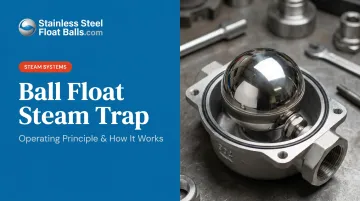
A ball float steam trap is a mechanical steam trap that uses the buoyancy of a sealed hollow sphere to sense condensate level and proportionally open or close a discharge valve. Condensate drains continuously; live steam stays in the system.
The Problem It Solves
When steam gives up its latent heat inside process equipment, it condenses into liquid. If that condensate isn't removed promptly, three problems follow:
- Heat transfer efficiency drops as condensate backs up against heating surfaces
- Water hammer risk increases as slugs of liquid travel at steam velocity through the system
- Process temperatures drift, disrupting production consistency
The ball float steam trap solves this automatically, with no operator intervention and no external power.
What It Is Not
- Not a thermostatic trap — which responds to temperature change, not liquid level
- Not a thermodynamic disc trap — which uses velocity and phase-change dynamics
- Not a pressure relief valve or control valve in any sense
The ball float trap responds purely to liquid level, driven by buoyancy alone. ISO/DIS 6704 classifies it as a mechanical trap — actuated by condensate level, not temperature or fluid dynamics.
Two Design Variants
That classification shapes how the trap is built. Two main designs exist, both operating on the same buoyancy principle but differing in how the float connects to the valve:
| Design | How It Works | Key Difference |
|---|---|---|
| Lever-type | Float connects to a lever arm that operates a separate valve | More parts; lever pivot tolerances affect performance |
| Lever-free (direct float) | The float itself seals the orifice directly | Single moving part; float rotates over time, distributing wear |
In the lever-free design, the float rotates gradually during operation, continuously presenting a fresh sealing surface to the orifice. This distributes wear evenly across the float's surface rather than concentrating it at a single contact point — extending service life without added complexity.
How a Ball Float Steam Trap Works
The trap operates through a defined sequence driven entirely by physical behavior — buoyancy, gravity, and liquid level. No external power, control signal, or manual adjustment required.
Stage 1: Startup and Air Purging
On startup, the trap body fills with cold condensate and air. At this point, the float sits near the bottom and the main discharge valve is open, allowing condensate and cold air to begin draining.
The critical role here belongs to the thermostatic air vent — a small element (typically a balanced-pressure capsule) mounted at the top of the trap body. It opens at low temperatures and closes as steam temperature approaches, rapidly purging non-condensable air from the system.
Why does this matter? Spirax Sarco's air venting data puts the impact in concrete terms:
- At 2 bar absolute, a steam-air mixture containing 25% air by volume has a temperature of only 112°C versus 120°C for pure steam
- A 1 mm film of air provides thermal resistance equivalent to approximately 15 meters of copper pipe
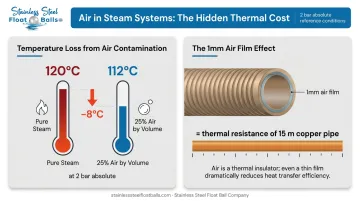
A failed or missing air vent doesn't just slow warm-up marginally — it can make full process temperature unachievable until the air is manually purged.
Stage 2: Float-Driven Valve Modulation
Once the system reaches operating temperature, the core mechanism takes over.
As condensate accumulates in the trap body, it raises the hollow float ball. Steam occupies the space above; condensate collects below. The float responds directly to the condensate level:
- Float rises → lever lifts (or float rises off orifice directly) → discharge valve opens → condensate exits
- Discharge orifice is positioned below the waterline → live steam, which remains above the condensate surface, never reaches the orifice
That submerged orifice position is the design feature that makes the ball float trap inherently steam-tight under normal conditions. Steam can't blow through what it can't reach.
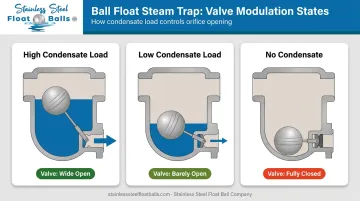
The valve opening is proportional to float position:
- High condensate load → float high → valve opens wide
- Low condensate load → float low → valve barely cracks open
- No condensate → float at bottom → valve closed
This continuous modulation sets float traps apart from on/off alternatives — they maintain steady discharge across load swings rather than cycling between fully open and fully closed.
Stage 3: Self-Regulation Under Varying Load
That modulation works in both directions. As the valve drains condensate, the liquid level drops, the float descends, and the valve throttles toward closed. If condensate load increases — because the process is pulling more steam — the float rises and the valve opens more. This feedback loop is entirely passive.
One important selection constraint: the discharge orifice is sized for the trap's maximum operating pressure (PMO). If system pressure exceeds the trap's rated PMO, the pressure differential across the valve can prevent it from opening — a condition known as pressure block.
Match your trap's PMO to your actual operating pressure range. A mismatch doesn't cause gradual performance loss — it means the trap may never open properly, leaving condensate to back up and waterlog your equipment from day one.
Key Components Inside a Ball Float Steam Trap
Hollow Ball Float
The float is the entire sensing mechanism. A sealed hollow sphere — typically stainless steel — must maintain structural integrity through thousands of pressure and thermal cycles. If the float develops a crack and fills with condensate, it sinks permanently. The trap then either stays open (continuous steam loss) or fails to drain (waterlogged equipment).
Float ball quality directly determines trap service life. Wall thickness, weld integrity, and pressure testing all matter. Stainless Steel Float Ball Company manufactures pressure-tested 304SS and 316SS float balls sized for steam trap service, where operating pressures can vary substantially between systems.
Thermostatic Air Vent
Mounted at the top of the trap body, the air vent handles startup air purging. A balanced-pressure capsule contains a liquid mixture that vaporizes as steam temperature approaches, expanding the capsule and closing the vent. It opens again when the system cools.
Failure mode to know: a stuck-open air vent vents live steam continuously through the top of the trap body — often misdiagnosed as a main valve failure.
Lever and Valve Assembly (Lever-Type)
In lever-type designs, a pivoting arm translates float movement into valve movement. Lever pivot tolerances matter — excessive clearance causes valve chatter and accelerated seat erosion. The valve head and orifice seat are matched components; swapping one without the other typically results in poor sealing.
Trap Body and Discharge Orifice
The pressure-rated body houses all internals. Body material selection follows operating requirements:
- Cast iron — standard for moderate pressure/temperature service
- SG iron — higher pressure ratings (Spirax FT14 SG iron versions reach PMO of 21 barg)
- Stainless steel — corrosive service or clean-steam applications (food, pharmaceutical, chemical)
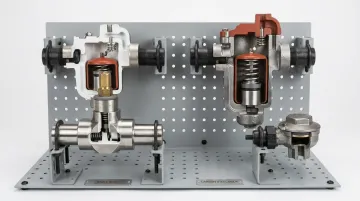
The submerged orifice position is the physical barrier keeping live steam contained — its geometry and depth below the operating waterline define the trap's steam retention capability.
Inlet Strainer
An upstream screen catches pipe scale, rust, and weld debris before it reaches the float chamber. Spirax Sarco notes that steam service commonly uses Y-type strainers with hole sizes of 0.8 mm to 3.2 mm; finer mesh screens down to 0.07 mm are available for clean-service applications.
A trap installed without an upstream strainer is exposed to every piece of pipeline debris that passes through — debris that can jam the valve open and cause continuous steam blow-through.
Where Ball Float Steam Traps Are Used
Ball float traps perform best on process equipment where condensate load varies with production demand. The continuous modulating discharge tracks load changes without backing up condensate during low-load periods or flooding during high-load periods.
Suited applications:
- Shell-and-tube heat exchangers
- Jacketed kettles and reactor vessels
- Steam coils in air handling units
- Bioreactors, fermenters, and sterilizers
- Cylinder dryers and roller heat exchangers
Where Float Traps Are Less Suitable
Steam main drip legs and tracer lines call for a different approach. Two situations where ball float traps are not the best fit:
- Tracer lines: Where condensate subcooling is the design objective (using sensible heat to maintain product temperature below steam saturation), thermostatic traps are the right choice.
- Severe water hammer: High-impact condensate slugs can damage the hollow float. Good upstream steam separation and strainer protection are essential wherever float traps are installed.
Ball Float Steam Trap vs. Other Types
| Trap Type | Discharge Pattern | Best Fit | Key Limitation |
|---|---|---|---|
| Ball float / F&T | Continuous, modulating | Variable-load process equipment | Larger, more expensive; sensitive to water hammer |
| Inverted bucket | Intermittent (batch cycles) | Steam mains, steady-load drip legs | Can lose water seal if pressure fluctuates suddenly |
| Thermodynamic disc | Intermittent (blast) | Steam mains, high-pressure tracing | Rapid cycling reduces service life on variable loads |
Float traps discharge condensate continuously, so it never accumulates in the equipment between cycles. On a heat exchanger, that means consistent surface temperatures and consistent heat transfer — not the temperature oscillation that comes with batch-discharge traps.
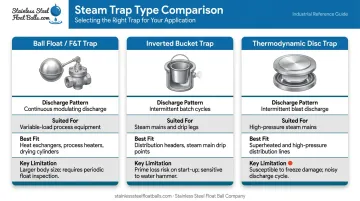
Float traps are physically larger and cost more than disc or bucket traps of equivalent capacity. For process equipment where temperature precision matters, that trade-off is usually worth it. For steam main drainage — where intermittent discharge is perfectly adequate — a simpler inverted bucket or thermodynamic disc trap is the more practical choice.
Frequently Asked Questions
What is the operating principle of a steam trap?
Steam traps detect the difference between steam and condensate. In ball float traps, this is done through buoyancy: condensate accumulates in the trap body, lifting the hollow float and opening a discharge valve. Live steam — less dense and sitting above the waterline — never reaches the submerged orifice, so it stays in the system.
How can you tell if a ball float steam trap is working properly?
A working trap produces steady, modulating condensate flow and a measurable temperature drop from inlet to outlet. A failed-open trap hisses loudly and discharges steam. A waterlogged trap is silent with a cool inlet — the float has filled with condensate and sunk.
What is the difference between a float steam trap and an inverted bucket steam trap?
A float trap modulates continuously — the valve stays open as long as condensate is present. An inverted bucket trap cycles in batches as steam fills and empties the bucket. Float traps suit variable-load process equipment; bucket traps suit steady-load drip leg applications.
What causes a ball float steam trap to fail?
Two common failure modes: a cracked float that fills with condensate and sinks (causing waterlogging or continuous open discharge), and a fouled valve seat from pipeline debris that prevents proper sealing. Installing an upstream strainer before the trap protects against debris-driven seat failure.
What material is the float ball made of, and why does it matter?
Stainless steel is standard — it resists corrosion from hot condensate and handles the pressure cycles of steam operation. A float that corrodes or cracks fills with condensate and fails. 304SS covers most applications; 316SS is the choice for aggressive condensate chemistry or chloride exposure. Stainless Steel Float Ball Company manufactures pressure-tested float balls in both grades specifically for steam trap use.
Can a ball float steam trap handle varying condensate loads?
Yes — this is one of its primary advantages over alternatives. Because valve opening is proportional to float position, the trap adjusts automatically: float high and valve wide open at peak load; float low and valve barely cracked at minimum load. That proportional response is what makes float traps the right choice for process equipment with fluctuating heating demand.
Conclusion
The ball float steam trap's operating principle is entirely mechanical: condensate accumulates, buoyancy lifts the float, the float opens the valve, condensate drains, and the float descends to throttle the valve back. That feedback loop runs continuously, responds in real time to load changes, and requires no external control.
Understanding how the float ball drives valve behavior makes selection decisions clearer. Each specification choice connects directly to that buoyancy mechanism:
- Float ball material and pressure rating determine how long the trap survives in service
- PMO matched to operating pressure determines whether the valve can open at all
- Upstream strainer installation determines whether debris reaches the valve seat
- Float ball geometry and wall thickness affect buoyancy response under varying condensate loads
Get those four variables right, and the trap does the rest on its own.