This guide covers what you need before selecting a monitoring method, three proven approaches (float-based, hydrostatic pressure, and non-contact), how to interpret readings accurately, and which errors to avoid.
Key Takeaways
- Match your monitoring method to the chemical's density, corrosiveness, and viscosity — no single method works for every application
- Float-based, hydrostatic/pressure, and non-contact (ultrasonic or radar) are the three primary methods
- All wetted components must be verified for chemical compatibility before installation
- Fouling, drift, and foam can cause misread signals that carry the same operational risk as a failed sensor
- Use a sight glass as a backup check only — it is not reliable enough for primary monitoring of hazardous chemicals
What You Need to Monitor Chemical Tank Levels
Before choosing a method, evaluate three variables:
- Chemical properties: Check density, corrosiveness, viscosity, and vapor behavior — these determine which sensor materials and methods are safe to use
- Tank geometry: Note whether the tank is open or closed, atmospheric or pressurized, and whether agitators or internal structures affect sensor placement
- Measurement precision: Decide whether you need a point-level alert (high/low alarm) or continuous real-time level data
Tools and Access Requirements
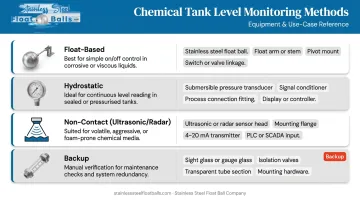
| Method | Required Equipment |
|---|---|
| Float-based | Float ball with compatible fittings, float arm or cable guide, level switch or transmitter, display/controller |
| Hydrostatic | Submersible or differential pressure transmitter, compatible diaphragm material, signal cable, 4–20 mA display |
| Non-contact (ultrasonic/radar) | Transmitter with PTFE antenna/transducer, top-of-tank nozzle access, 4–20 mA or RS-485 output |
| Backup (all methods) | Sight glass for visual cross-check |
For corrosive or hazardous chemicals, verify chemical compatibility for every wetted component — float balls, sensor diaphragms, and housing materials — before installation. Stainless Steel Float Ball Company manufactures 304SS and 316SS float balls pressure-tested to your specifications, with custom threading and fittings designed to integrate with existing tank assemblies.
Preconditions and Setup
- Calibrate sensors only when the tank is at a stable, known fill state — not actively filling or draining
- Mount sensors level and at the manufacturer-specified distance from walls, baffles, and internal structures
- Confirm ambient temperature and vapor conditions fall within the sensor's rated operating range before commissioning
Methods to Monitor Chemical Tank Levels
No method is universally superior. The right choice depends on whether the chemical is corrosive, whether the tank is pressurized, and how much measurement precision the process requires.
Method 1: Float-Based Level Monitoring
A float assembly rises and falls with the liquid surface, either actuating a switch at defined trigger points (point-level detection) or transmitting a continuous position signal to a controller for full-range output.
Step-by-step:
- Confirm material compatibility and install the float through the designated nozzle or access port, verifying the float moves freely without contacting tank walls or internal structures
- Connect the float mechanism to the level switch or transmitter; set trigger points for high-level alarm, low-level alarm, or continuous output based on operational limits
- Fill to a known volume and verify that float position matches the expected display reading; adjust arm length or calibration set-points if readings deviate
Material grade selection: Both 304SS and 316SS grades are used in chemical manufacturing environments. The BSSA confirms that 304 and 316 stainless steels can resist sodium hydroxide below 80°C up to solubility limits, but neither grade should be used with hydrochloric acid at any concentration or temperature. Always check compatibility against your specific chemical, concentration, and operating temperature before specifying a material grade.
Stainless Steel Float Ball Company stocks round sizes from 1½" to 14" and oblong configurations from 2×6" to 9×14", with threading options including ¼ NPT through ¾ NPT and UNC machine threads — ready to ship worldwide.
Pros: Mechanically simple, cost-effective, and reliable for most atmospheric tanks with non-foaming liquids.
Cons: Floats can accumulate coating or corrode with aggressive chemicals over time. Not recommended for heavily foaming media or extremely high-viscosity liquids without confirming suitability with product-specific data.
Method 2: Hydrostatic Pressure Monitoring
A submersible pressure sensor at the tank bottom measures the pressure exerted by the liquid column above it. Since pressure is proportional to liquid height and density, the reading converts directly to a level value — with no moving parts.
Step-by-step:
- Lower the submersible sensor to the designated mounting point; if a vented cable is used, confirm it exits to atmosphere so the reading reflects gauge pressure from the liquid column only
- Zero the sensor at empty and span-calibrate at a known fill level, inputting the liquid's specific gravity to convert pressure readings accurately into level units
- Monitor the live output and log baseline readings for ongoing comparison to detect sensor drift or diaphragm fouling early
Diaphragm material determines how well the sensor holds up over time. Ceramic, PTFE, and Hastelloy each suit different chemical environments — use the manufacturer's compatibility guide for your specific chemical before specifying.
Pros: Accurate continuous measurement with no top-of-tank access required. Works well in sealed or pressurized tanks when configured as a differential pressure measurement.
Cons: The sensor contacts the chemical directly, so diaphragm selection and periodic inspection directly determine long-term accuracy.
Method 3: Non-Contact Monitoring (Ultrasonic and Radar)
Non-contact sensors mount at the top of the tank and measure the time it takes for an emitted signal — sound waves for ultrasonic, microwave pulses for radar — to reflect off the liquid surface and return. No part of the sensor touches the chemical.
Step-by-step:
- Mount the sensor at the top of the tank, centered over the liquid surface and positioned away from walls, ladders, or agitator blades that could produce false echo returns; configure the blocking distance (dead zone) and measurement range
- Perform an empty tank scan to map and suppress false echoes from internal structures; fill to a reference level and verify the transmitter output matches the known depth
- Enable echo signal quality monitoring if available; record the baseline signal strength so future degradation from foam, vapor buildup, or sensor face condensation can be detected early
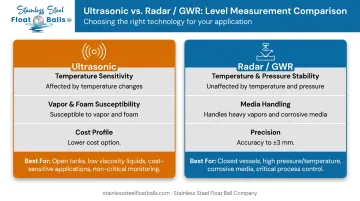
Ultrasonic vs. radar: Ultrasonic accuracy can vary significantly with temperature changes and is susceptible to vapor and foam interference. Radar is unaffected by temperature, pressure, and most vapor conditions — and guided wave radar (GWR) delivers accuracy as tight as ±3 mm (per the Rosemount 5300 GWR datasheet). For tanks with heavy vapors, extreme temperatures, or corrosive media, radar is the stronger choice.
Pros: Ideal where no sensor contact with the chemical is acceptable. Radar handles vapor, pressure, and corrosive service that would degrade contact-based methods.
Cons: Both methods require unobstructed top-of-tank access and can be affected by internal agitators or foam layers if not properly configured.
How to Interpret Chemical Tank Level Readings
Acting on a false reading carries the same operational risk as having no reading at all. Use these four categories to assess any reading:
Normal / Acceptable
A steady output signal within the tank's operational range, consistent with recent fill and draw history, with no unexplained jumps or drops. Log the reading and continue normal operation.
Minor Deviation
A reading that drifts slightly outside the expected range without triggering a high/low alarm. This often points to sensor fouling, float coating, or calibration drift. Inspect the sensor or float for buildup, recalibrate, and recheck within 24 hours.
Out-of-Spec / Alarm Condition
Erratic fluctuations or triggered high/low alarms indicate either a real overfill/underfill risk or sensor failure — not always both. Cross-check immediately with a secondary method such as a sight glass or manual dip. If overfill risk exists, isolate the tank first, then determine whether the sensor or the actual level is at fault.
Signal Loss or Frozen Reading
A reading that stops updating — or holds at a fixed value when liquid movement is expected — is a critical failure. Treat the tank as unmonitored, apply manual backup checks, and replace or service the sensor before resuming normal operation.
Common Errors and Safety Best Practices
Monitoring Errors to Avoid
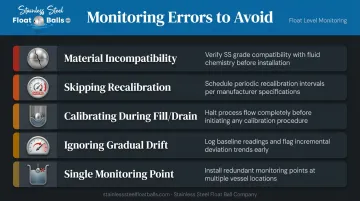
Even well-designed monitoring setups fail when installation or maintenance shortcuts introduce systematic errors. These are the most common ones to watch for:
- Verify sensor and float wetted materials against the specific chemical — not just its chemical family. Incompatible materials degrade quickly and produce inaccurate readings
- Re-zero and recalibrate after every tank cleaning, product changeover, or maintenance event; skipping this step introduces persistent offset errors that compound over time
- Stabilize the tank before calibrating — filling or draining creates unstable conditions that make readings unreliable
- Cross-check live readings against periodic manual dip measurements; gradual drift accumulates slowly over weeks and is easy to miss until it becomes a safety issue
- Use a secondary verification method on critical tanks; a single monitoring point is a single point of failure
Safety Precautions
Correcting measurement errors is the operational side of tank monitoring — but safe access to tanks and sensors requires its own discipline. Follow these precautions any time you're working near chemical tanks:
- Follow lockout/tagout (LOTO) procedures per OSHA 1910.147 before accessing tanks or replacing sensors
- Wear appropriate PPE — chemical-resistant gloves, eye protection, and respiratory protection as required by the chemical's SDS, per OSHA 1910.132
- Ensure adequate ventilation when working near open chemical tanks
- Confirm that replacement sensors and float components carry ATEX/IECEx certification for the correct zone classification before installing them in flammable vapor environments
Conclusion
Reliable chemical tank level monitoring depends on three decisions made in alignment: selecting a method that matches the chemical's properties and tank design, ensuring all components are built from compatible materials, and interpreting readings against established baselines rather than in isolation.
Regular calibration checks, material inspections, and a backup monitoring method are what separate a safe, compliant operation from one exposed to spills, process failures, or regulatory penalties. For float-based systems in particular, that means choosing components — float balls, fittings, and housings — sized and fabricated for the specific chemical and pressure conditions of your tank. Get the component selection right, and the monitoring method will perform as intended.
Frequently Asked Questions
What industries use level sensors?
Level sensors are used in chemical manufacturing, water and wastewater treatment, food and beverage processing, oil and gas, pharmaceuticals, and industrial facilities including sump pump and steam trap systems — any application where liquid must be monitored within a vessel.
What is the most accurate method to monitor chemical tank levels?
Radar, particularly guided wave radar (GWR), delivers the highest accuracy in demanding chemical environments because it is unaffected by vapors, foam, temperature swings, or pressure changes. Accuracy is also a function of proper calibration and the absence of internal obstructions.
What is the difference between point level and continuous level measurement?
Point level measurement detects a specific threshold — a high alarm or low alarm — and typically triggers pumps or control actions. Continuous measurement monitors the full range of liquid height in real time, providing ongoing data for process control and inventory tracking.
How often should chemical tank level sensors be calibrated or inspected?
Verify calibration at every scheduled maintenance interval — typically quarterly or semi-annually. Inspect wetted components such as float balls and sensor diaphragms for corrosion or coating buildup at the same time. More aggressive chemicals warrant more frequent checks.
Can float-based sensors be used in tanks storing corrosive chemicals?
Yes, provided all wetted components are constructed from a chemically compatible material. Stainless steel float balls (304SS or 316SS) are widely used in corrosive applications, but material selection must be validated against the specific chemical, its concentration, and operating temperature.